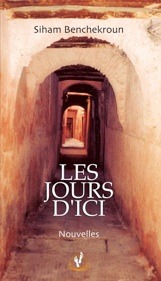
Our Days
Feminist short stories from Morocco by Siham Benchekroun.
About the author
Siham Benchekroun is a French-language novelist, poet, and short story writer. She began her career in 1999 with bestselling novel Oser Vivre, questioning the norms of couples and marriage in Morocco. The novel features on the country's academic programmes. Benchekroun went on to publish a poetry collection, À Toi (2000); two short story collections, Les Jours d’Ici (2003) and Amoureuses (2012); a novel, Chama (2008); a collection of Andalusian folk tales, Contes de Tétouan (2013); and an essay, L’Héritage des Femmes (2017). A writer and poet of private lives, Benchekroun’s works explore the different sides of the human psyche, love, and relationships between men and women. Her works advocate for women and their roles in Moroccan society.
About Our Days
Walls too close. Faces too ugly. Dirty, cold, small, the world to which we're confined.”
Benchekroun is a liberal feminist whose work is explicitly rooted in Moroccan culture. For Benchekroun, the decision to write in French is straightforward: it is her strongest language in which to confront and explore issues in Morocco, and not a “westernisation” of her cultural identity. These priorities are at the forefront of her work, and pose an interesting challenge in translation. The tendency in the anglophone West is still to “smooth over” linguistic differences. Feminist translation theory challenges this trend, calling on translators to preserve what we perceive as difference and deliver the source culture to the reader. In this way, translation can contribute to our concept of the universal as diverse and complex, rather than simplifying the universal under one westernised “world view”.
With this comment on languages in Morocco in mind, the short story ‘Living Words’ is an interesting case for translation. Its very essence is the French language, which inevitably must be lost in translation. As we move through the story, we see that the French language seems to keep the narrator in a purgatorial state. He pauses on the idea that ‘words are arranged into social categories’ and, despite learning the ‘language of the educated’, he remains excluded from it. This idea has been researched by academics like Moha Ennaji, who are interested in the role of different languages in Morocco.